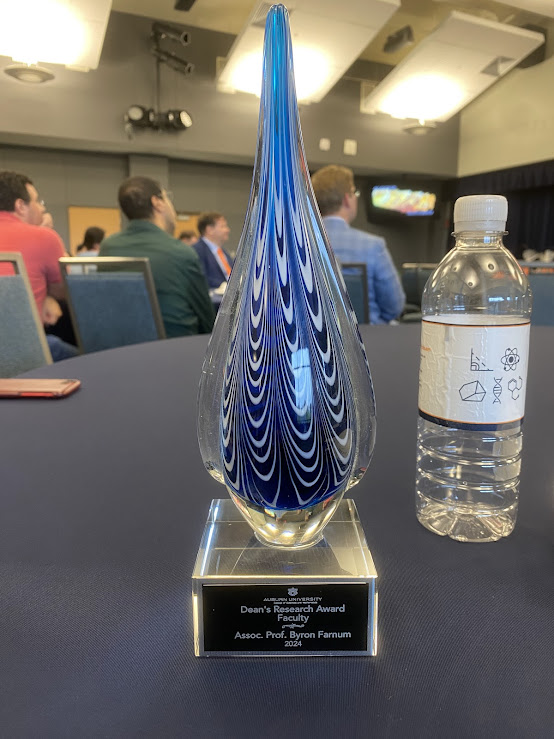
Dr. Farnum was awarded the Dean’s Faculty Research Award for 2024! This award is given annually to a single faculty member in the College of Science and Mathematics for outstanding research achievement.
Inorganic Chemistry Research Group
Dr. Farnum was awarded the Dean’s Faculty Research Award for 2024! This award is given annually to a single faculty member in the College of Science and Mathematics for outstanding research achievement.
Rezoanul Islam’s latest work was published in Inorganic Chemistry, detailing the role solvent coordination on the two-electron Ni(IV/II) redox cycle of nickel bis(diethyldithiocarbamate). https://pubs.acs.org/doi/full/10.1021/acs.inorgchem.4c02024
Our previous work had shown that pyridine can coordinate the intermediate Ni(III) redox state when oxidized electrochemically from Ni(II). This new publication shows how the solvent coordination ability, measured by the donor number, directly influences the rate at which Ni(III) is converted to Ni(IV) via disproportionation. Solvents with higher donor numbers, like pyridine, slow this rate while solvents with lower donor numbers enhance this rate. Interestingly, solvents with no coordination ability like dichloromethane still show conversion to Ni(IV), but through a sequential one-electron EEC process instead of a two-electron ECE process, showing that solvent coordination is critical to achieving a single two-electron redox wave in the cyclic voltammogram. Temperature dependent CV data also measured the enthalpy and entropy of activation for the chemical step in the ECE cycle, showing a net associative rate-limiting step. We therefore proposed that this step must occur via the merging of Ni(III) and Ni(II) complexes to facilitate the exchange of a diethyldithiocarbamate ligand.
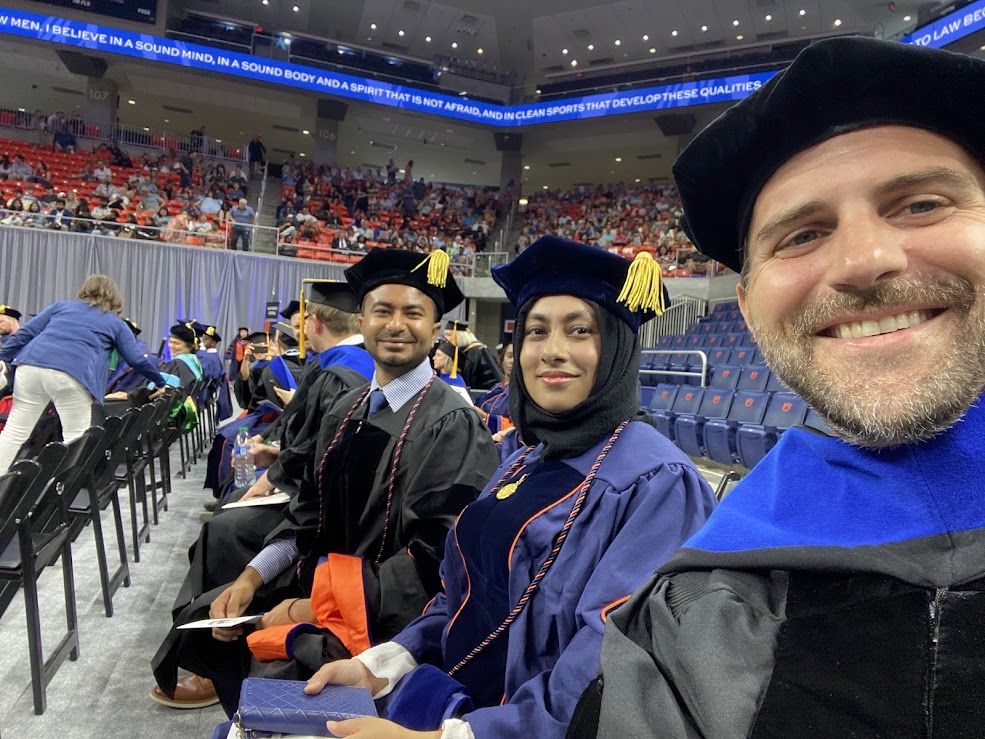
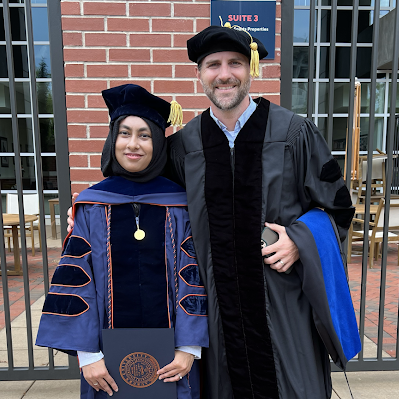
Humaira Yeasmin and Rezonaul Islam were hooded at the summer commencement ceremony. Always fun to dress up in the floppy hat.
In collaboration with the Goldsmith lab at AU, the Farnum lab has received new funding from the Department of Energy. This grant will focus on understanding the mechanisms of ORR electrocatalysis using iron and cobalt based molecular catalysts that contain ligand tethered quinol groups. The metal-ligand cooperativity of between the metal and quinol functionality yields pronounced ORR activity at mild overpotentials. We are excited to pursue this work in collaboration and thankful to the DOE for awarding us this grant!
Rezoanul Islam successfully defended his thesis to obtain his PhD. Number 6 for the group and one day after Humaira defended her thesis. Rezonaul now heads to UNC-Greensboro for a postdoc with Shabnam Hematian.
 The Farnum Group