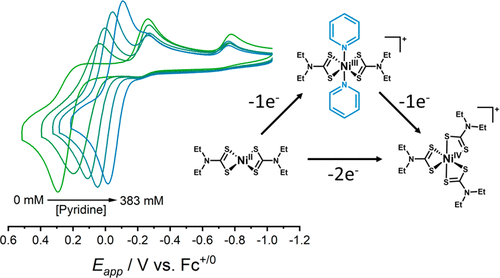
The storage of electrochemical energy in molecular species is a critical challenge to many energy conversion strategies; from dye-sensitized solar cells to photo/electrocatalytic water splitting to redox flow batteries. Arguably, the best method to store electrochemical energy within molecules is by the formation of chemical bonds coupled to multi-electron oxidation/reduction reactions. For example, water splitting results in the 2e– reduction of 2H+ to H2 to form an H-H bond and the 4e– oxidation of 2H2O to O2 to form an O=O double bond.
Research
Oxygen Reduction Reaction (ORR) Catalysis
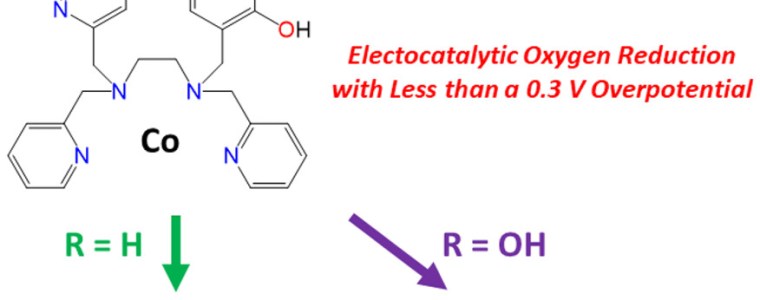
Oxygen reduction via the oxygen reduction reaction (ORR) is fundamentally important to many energy conversion and storage technologies such as metal-air batteries and fuel cells. This reaction requires the combination of four electrons and four protons to achieve oxygen reduction, whereby the O=O double bond is broken and two molecules of water are formed. Central to the use of this reaction in technological applications is the development and fundamental understanding of catalysts capable of assisting in this complicated reaction.
 The Farnum Group